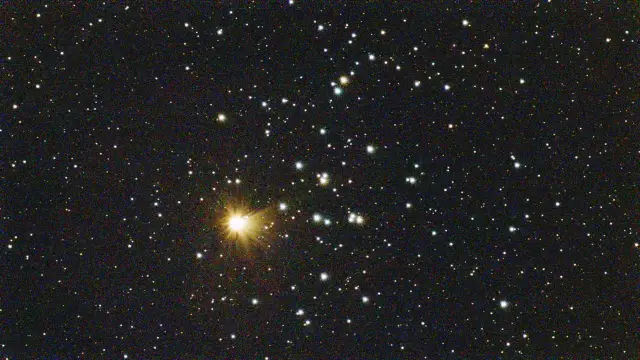
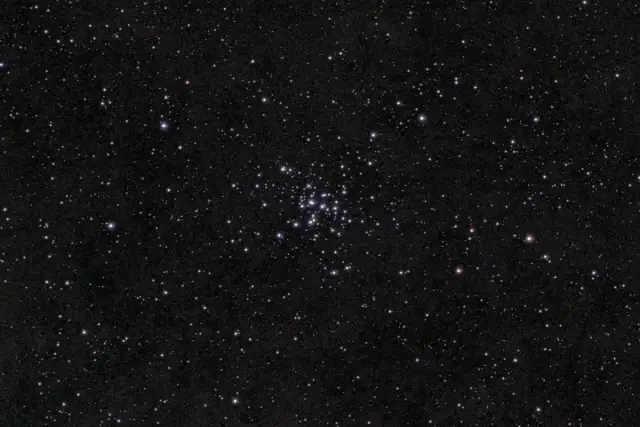
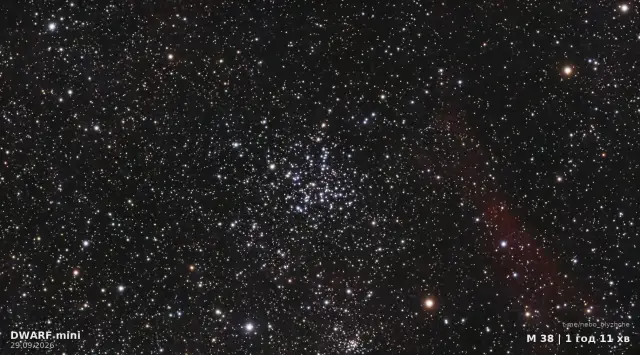
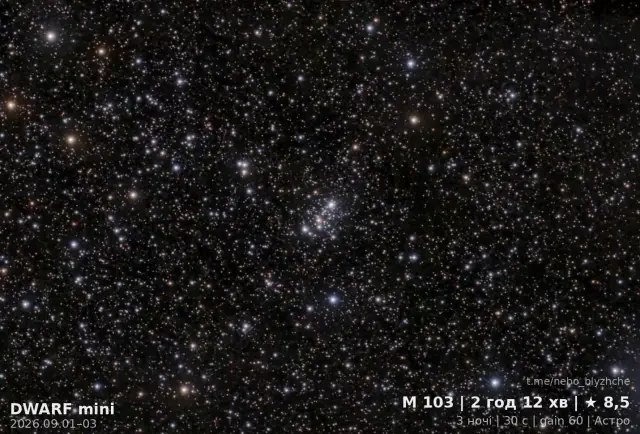
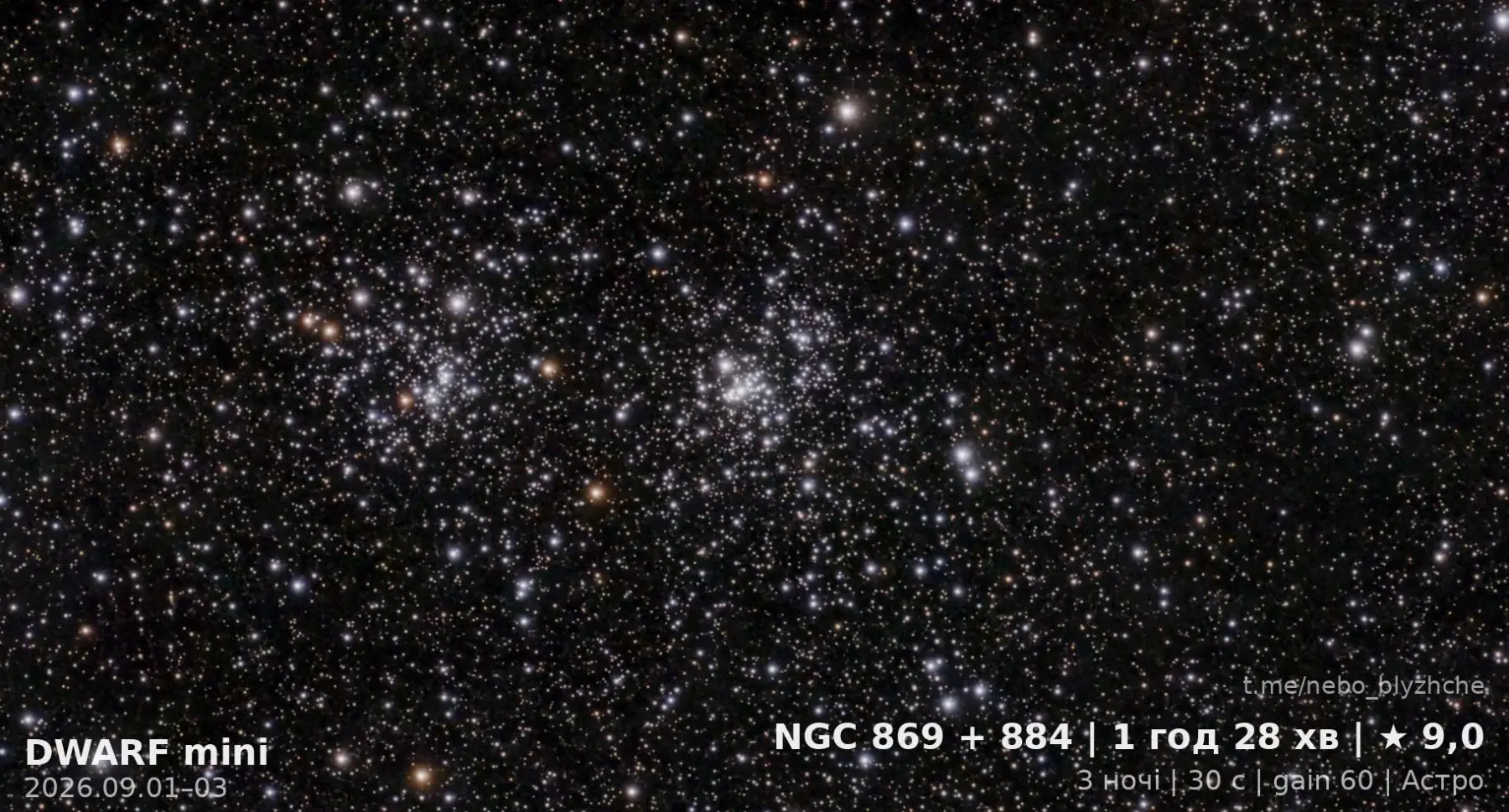
Double Cluster in Perseus (h Persei)
NGC 869 · Cluster · Perseus
- Status
- Captured
- Light gathered
- 1 h 29 min
- Goal
- 1 h
- Nights
- 3
- First and last night
- 1 September … 3 September
- Image from
- 3 September 2026
- Telescope
- DWARF Mini, city balcony
About the object
The Double Cluster in Perseus, h and χ Persei, two young open clusters visible to the eye as a hazy patch between Perseus and Cassiopeia. Both were born from the same cloud only a few million years ago, lie at almost the same distance and move together. Each holds hundreds of hot blue stars and a few red supergiants whose colour stands out even in a city sky.
Distance: about 7,500 light-years, apparent size in the sky: 2 × 30′, constellation Perseus.
How it was shot
Everything here was shot with a DWARF Mini smart telescope from a balcony in a city in Ukraine: light-polluted sky, only the eastern half of it visible, and a roof overhang that cuts off the south. 3 nights (1 night in August and 2 in September), 3 sessions, 177 frames with exposures of 30 s, without a filter, in broadband. The stack holds 1 h 29 min of light; the longest night, 31 August, gave 39 min. The goal for this object is 1 h, and it is reached. First night 1 September 2026, last one 3 September 2026.
Double Cluster in Perseus (h Persei) in the night log: 31 August, 1 September, 2 September.
How it went
Both clusters fit into the DWARF Mini field at once, so this was a quick and rewarding object: three nights of thirty-second frames without a filter. The goal for bright clusters is modest and was reached in one go. The red supergiants among the blue stars showed up right away, with no colour boost.
3D flight through the image
A short loop of a 3D flight through this image. Full flights come out daily on TikTok, Instagram and YouTube Shorts.
More images
All objects