DWARF Mini from a city balcony: an honest account
A smart telescope, a light-polluted sky and half a horizon
What the device is
DWARF Mini is a small smart telescope: a lens with a camera, a motorised mount and a computer in one body the size of a thick book. It finds the target itself, tracks it, takes hundreds of short frames and stacks them on board; a phone app is all the control there is. I have had it since August 2026, and everything on this site was shot with it.
For deep sky I use its dual-band Hα/OIII filter, which passes the two main lines of nebular glow and blocks most of the street-light spectrum. Without the filter the device shoots broadband: that is how galaxies, clusters, the Moon and the planets are done.


The conditions, honestly
The balcony faces east. A roof overhang above it cuts off the south, so I see only the eastern half of the sky and anything culminating in the south is simply never available. Street lights burn until midnight and leave a visible gradient on one side of the frame; after they switch off the sky darkens by more than half in measured terms, and those are the frames that carry the result.
This is a city sky in Ukraine, roughly Bortle 6: the Milky Way is not visible, bright stars are. Every nebula here costs four to eight hours of total exposure gathered over several nights, where a dark site would need one or two.

What works
Stacking hours across nights. The device runs a plan by itself while I sleep, and a stack of several nights beats any single night. So far: 138.6 h of deep-sky light over 48 nights, 20 of 38 challenge objects captured.
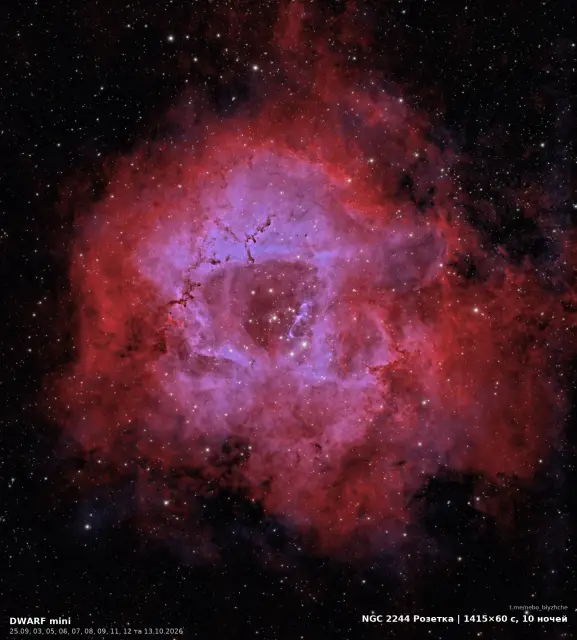
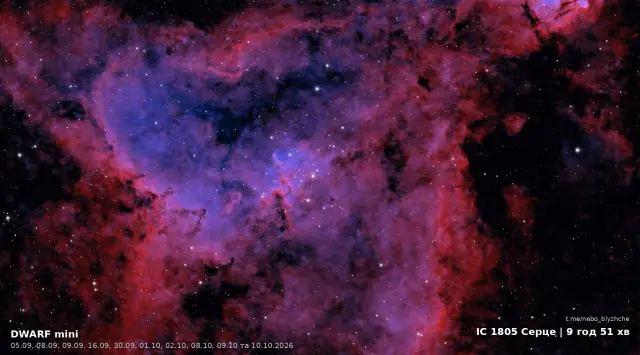
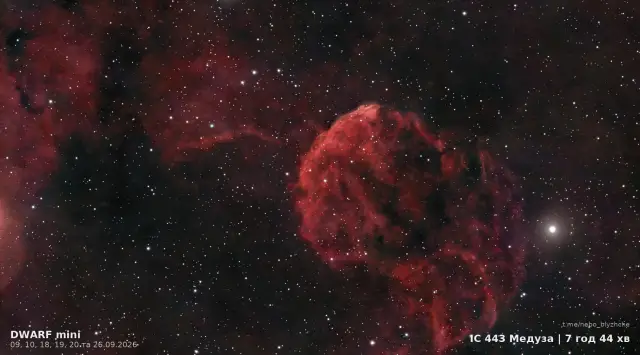
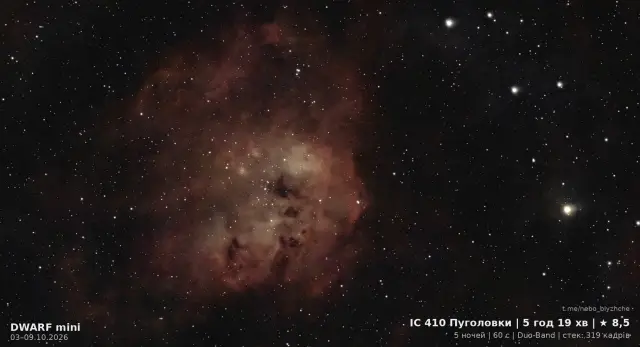
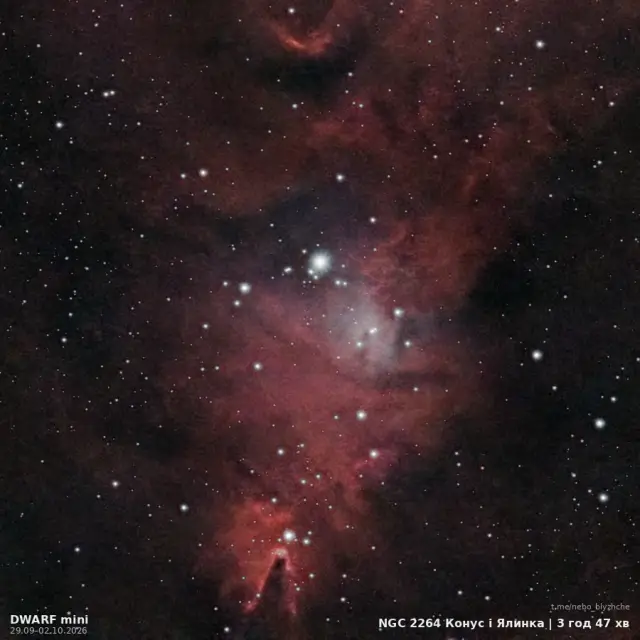
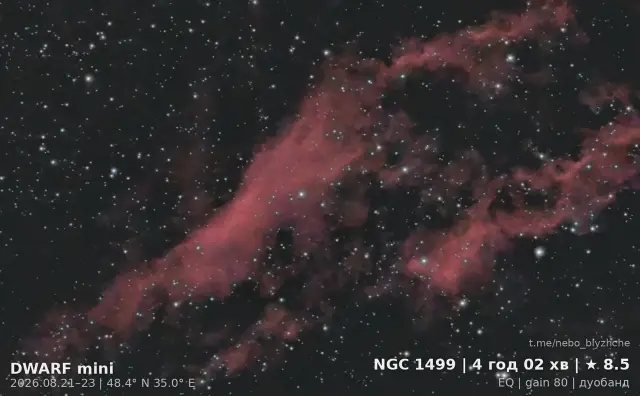
The dual-band filter on emission nebulae. The Rosette, the Heart, California or the Tadpoles come through from the city with a clean background; this is where the small device punches above its weight.
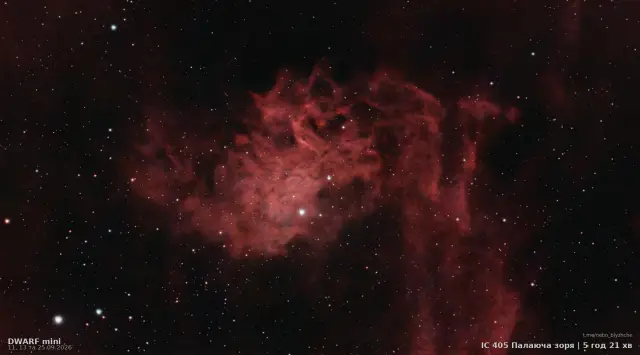
Re-stacking all frames of all nights together instead of trusting the per-night stack from the device. On the Flaming Star this gave about 20 percent better signal-to-noise from the same data; on Orion it cut background noise roughly one and a half times.
Mosaics. The Rosette does not fit into the field, and the built-in mosaic mode stitched two panels across ten nights without manual alignment.

What does not
Galaxies. They shine across the whole spectrum, so the filter does not help, and most have low surface brightness. Andromeda and Triangulum come out as recognisable but soft; galaxies at tens of millions of light-years are a few dozen pixels with a hint of structure. That is the honest limit of a small aperture in a city.
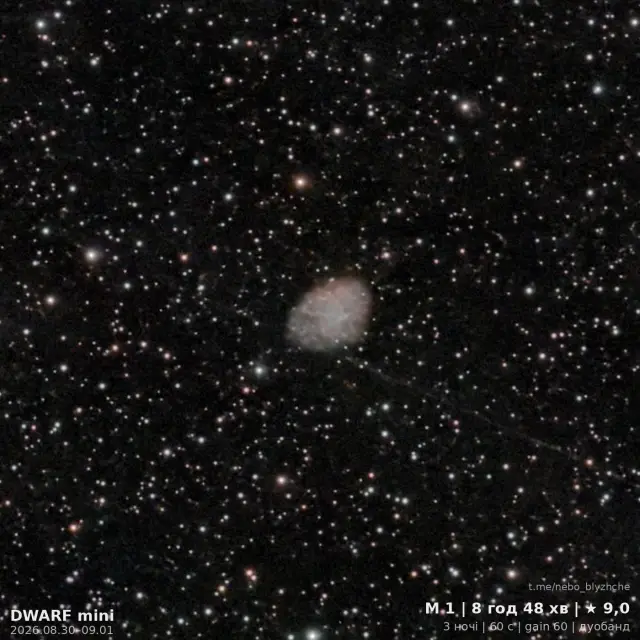
Fine detail. The Crab Nebula, Saturn's rings or the Horsehead itself are at the edge of what the optics resolve. The shape is there, the texture is not.
Long exposures. On the Horsehead the device rejected about half of all 180-second frames, a third of 90-second ones and only around 15 percent at 60 seconds. Tracking and light pollution together make three-minute frames a lottery from a balcony.
Heat. Planets and the Moon suffer from the air trembling above warm roofs; the best lunar frames come before dawn when the roofs have cooled.
Exposures and settings that settled in
Emission nebulae: 60 seconds at gain 80 through the dual-band filter. Long enough to collect signal, short enough that few frames are lost.
Bright nebulae with a bright core, like Orion: two series, 60 seconds for the outer parts and 15 seconds to keep the core from clipping, stacked together.
Clusters and galaxies: 30 seconds at gain 60 without a filter; 15 seconds when bright stars start to bloat.
The Moon, the Sun and planets: video mode at thousandths of a second, hundreds of frames, only the sharpest kept.
Accessories that earned their place
A 3D-printed dew shield lined with felt, from a free model on Printables. With street lights shining from the side it cuts noise by roughly 20 to 30 percent; late at night, with the lights off, it makes almost no difference.
A Bahtinov mask from the same set, used once to confirm that the autofocus really lands where it should. A cap for dark frames. A solar ND filter for the Sun, which passes less than a thousandth of the light; without it the Sun must never be pointed at.

Processing
The device produces a stacked image per night, but the real work starts afterwards: the raw frames of all nights are stacked again together, frames with clouds or low star counts are dropped by measured numbers rather than by eye, the city gradient is removed, and only then the colours of the nebula are stretched out of the background. Every object page shows which exposures, filters and nights went into its frame.
If your balcony looks like mine
Start with nebulae and the dual-band filter, not with galaxies: the first results will keep you going. Shoot after midnight whenever possible. Keep 60-second frames as the default and test longer ones on one night before committing a series. Keep every raw frame: re-stacking later is where most of the quality comes from. And set a goal in hours for each object, so that "done" means something.
Shot with this telescope
Full gallery