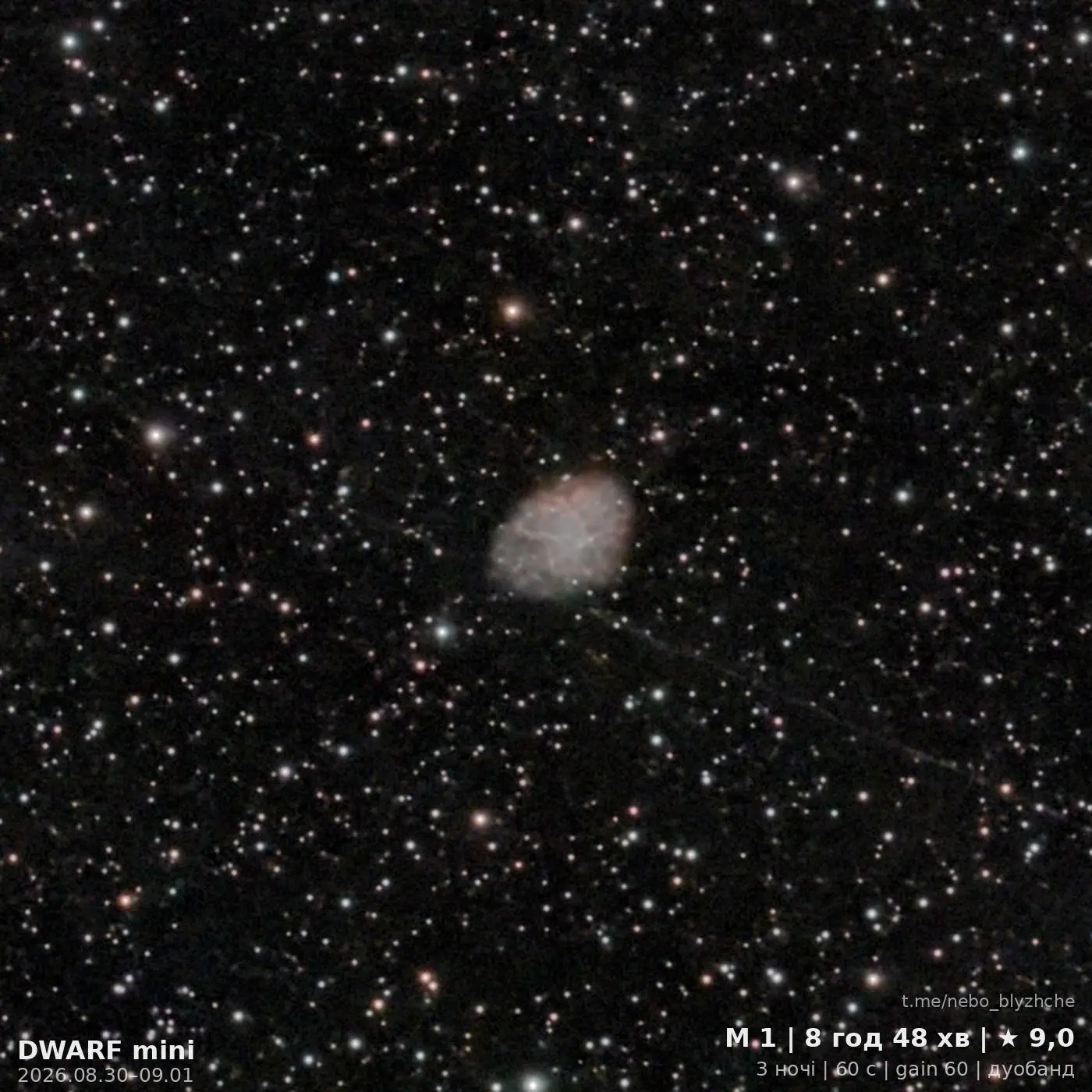
Crab Nebula
M1 · Nebula · Taurus
- Status
- Captured
- Light gathered
- 8 h 44 min
- Goal
- 6 h
- Nights
- 3
- First and last night
- 30 August … 1 September
- Image from
- 6 September 2026
- Telescope
- DWARF Mini, city balcony
About the object
The Crab Nebula in Taurus, the remnant of a supernova that Chinese astronomers recorded in 1054: for a few weeks the new star was visible even in daylight. At the centre of the cloud is a pulsar, a neutron star spinning thirty times a second that still powers the glow. The nebula expands at about fifteen hundred kilometres per second, and photographs decades apart show the difference.
Distance: about 6,500 light-years, apparent size in the sky: 7′ × 5′, constellation Taurus.
How it was shot
Everything here was shot with a DWARF Mini smart telescope from a balcony in a city in Ukraine: light-polluted sky, only the eastern half of it visible, and a roof overhang that cuts off the south. 3 nights (all in August), 3 sessions, 530 frames with exposures of 60 s, a dual-band Hα/OIII filter that passes only the glow of hydrogen and oxygen and blocks most of the city light pollution. The stack holds 8 h 44 min of light; the longest night, 29 August, gave 2 h 58 min. The goal for this object is 6 h, and it is reached. First night 30 August 2026, last one 1 September 2026.
Crab Nebula in the night log: 29 August, 30 August, 31 August.
How it went
The Crab is small and sits at the limit of DWARF Mini detail: in the frame it is only a handful of pixels across. Three dual-band nights at 60 seconds showed the shape and the filamentary structure, but not the fine threads. It is an object where the device honestly shows its limit, and the frame stands as a record that the Crab is reachable from a balcony.
3D flight through the image
A short loop of a 3D flight through this image. You can watch the full clip with sound right here.
More images
All objects