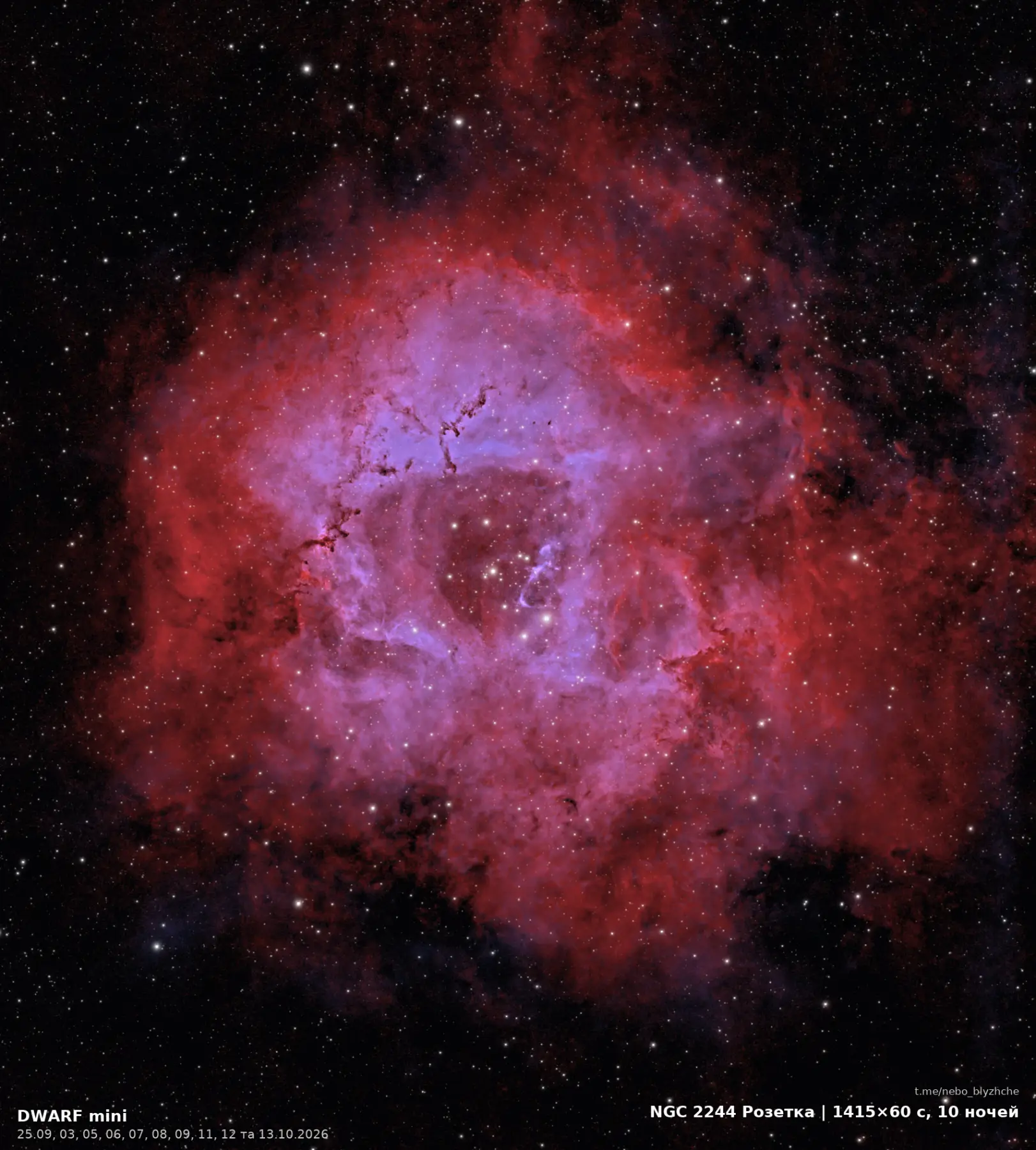
Rosette Nebula
NGC 2244 · Nebula · Monoceros
- Status
- Captured
- Light gathered
- 27 h 4 min
- Goal
- 4 h
- Nights
- 10
- First and last night
- 25 September … 13 October
- Image from
- 13 October 2026
- Telescope
- DWARF Mini, city balcony
About the object
The Rosette Nebula in Monoceros, one of the most beautiful emission nebulae of the winter sky. At its centre sits the young cluster NGC 2244: hot stars a few million years old have blown a cavity in the cloud with their wind and radiation, leaving the nebula looking like a flower with a hole in the middle. The petals glow in the red light of hydrogen, and along the edges of the cavity run dark dust filaments and 'elephant trunks' where new stars are forming.
Distance: about 5,200 light-years, apparent size in the sky: ≈ 1,3°, constellation Monoceros.
How it was shot
Everything here was shot with a DWARF Mini smart telescope from a balcony in a city in Ukraine: light-polluted sky, only the eastern half of it visible, and a roof overhang that cuts off the south. 10 nights (1 night in September and 9 in October), 10 sessions, 1,717 frames with exposures of 60 s, a dual-band Hα/OIII filter that passes only the glow of hydrogen and oxygen and blocks most of the city light pollution. The stack holds 27 h 4 min of light; the longest night, 12 October, gave 3 h 6 min. The goal for this object is 4 h, and it is reached. First night 25 September 2026, last one 13 October 2026.
Rosette Nebula in the night log: 24 September, 2 October, 4 October, 5 October, 6 October, 7 October, 8 October, 10 October, 11 October, 12 October.
How it went
The biggest series of the challenge. The Rosette does not fit into the frame, so it was shot as a two-panel mosaic, with the telescope alternating panels in twenty-minute blocks. Ten nights, more than fifteen hundred 60-second dual-band frames, about thirteen hours per panel. The object never climbs above 46 degrees and sets behind the roof earlier every night, so the series was closed by the Moon, not by choice. The seam between panels and frame selection on cloudy nights are the job of the final processing.
3D flight through the image
A short loop of a 3D flight through this image. Full flights come out daily on TikTok, Instagram and YouTube Shorts.
More images
All objects