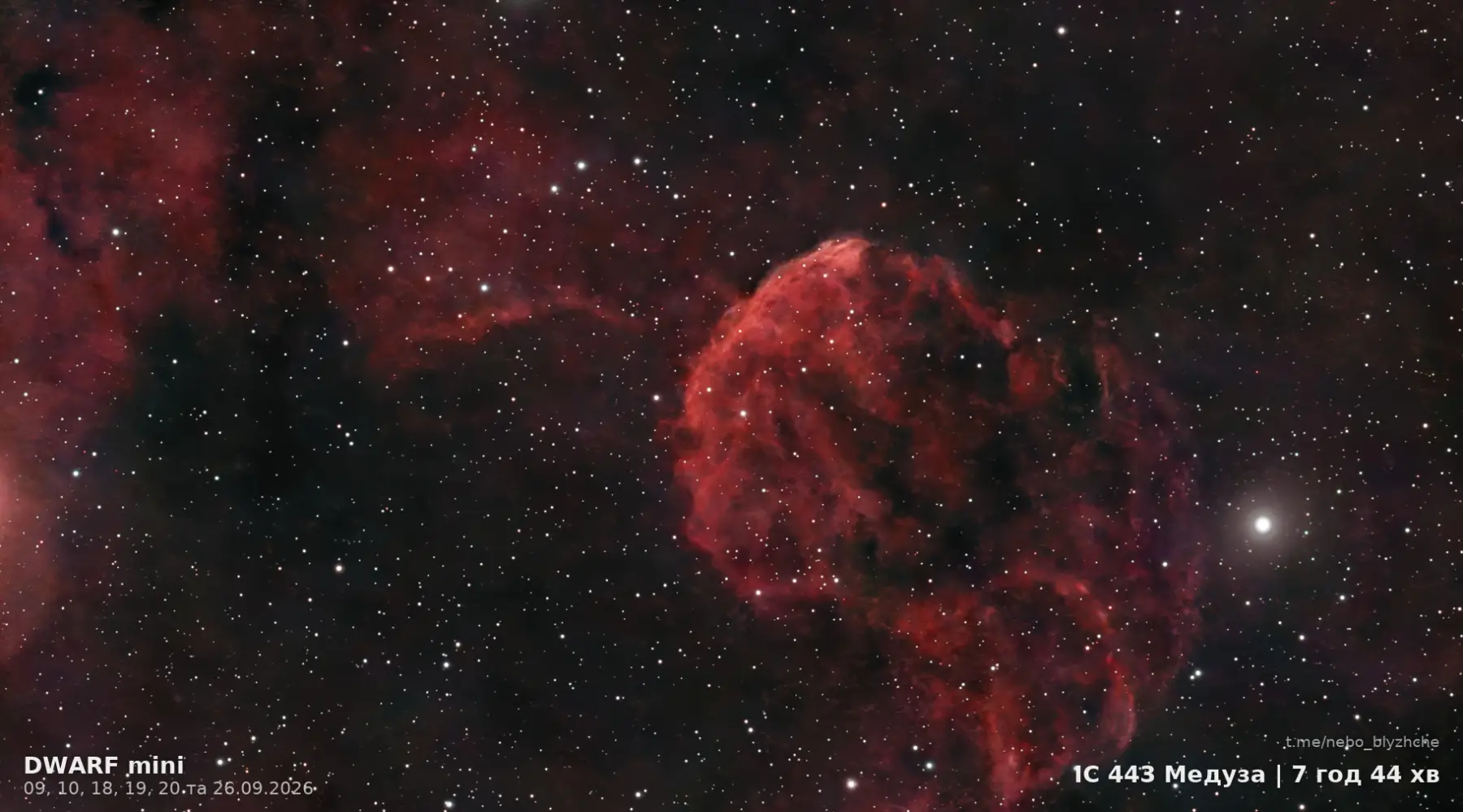
Jellyfish Nebula
IC 443 · Nebula · Gemini
- Status
- Captured
- Light gathered
- 7 h 17 min
- Goal
- 6 h
- Nights
- 6
- First and last night
- 9 September … 26 September
- Image from
- 26 September 2026
- Telescope
- DWARF Mini, city balcony
About the object
The Jellyfish Nebula in Gemini, the remnant of a supernova that exploded roughly thirty thousand years ago. The shock wave is still spreading through interstellar gas and making it glow; where it ran into a denser cloud the filaments are brighter, and those form the jellyfish's 'tentacles'. At the centre of the remnant is a neutron star, found by its X-ray emission.
Distance: about 5,000 light-years, apparent size in the sky: ≈ 50′, constellation Gemini.
How it was shot
Everything here was shot with a DWARF Mini smart telescope from a balcony in a city in Ukraine: light-polluted sky, only the eastern half of it visible, and a roof overhang that cuts off the south. 6 nights (all in September), 7 sessions, 425 frames with exposures of 60, 90 and 180 s, a dual-band Hα/OIII filter that passes only the glow of hydrogen and oxygen and blocks most of the city light pollution. The stack holds 7 h 17 min of light; the longest night, 25 September, gave 2 h 37 min. The goal for this object is 6 h, and it is reached. First night 9 September 2026, last one 26 September 2026.
Jellyfish Nebula in the night log: 8 September, 9 September, 17 September, 18 September, 19 September, 25 September.
How it went
Seven dual-band sessions with exposures of 180, 90 and 60 seconds: the Jellyfish was the testing ground for choosing exposure under a city sky, since 30- and 60-second frames are almost never rejected while three-minute ones often are. The filaments and the curled edge facing the dense cloud came out crisp; the object is closed in the challenge.
3D flight through the image
A short loop of a 3D flight through this image. You can watch the full clip with sound right here.
More images
All objects