Galaxy NGC 7331 (Caldwell 30) + SN 2026aaiv
C 30 · Galaxy · Pegasus
- Status
- Gathering light · 44%
- Light gathered
- 3 h 36 min
- Goal
- 8 h
- Nights
- 7
- First and last night
- 12 September … 11 October
- Image from
- 24 September 2026
- Telescope
- DWARF Mini, city balcony
About the object
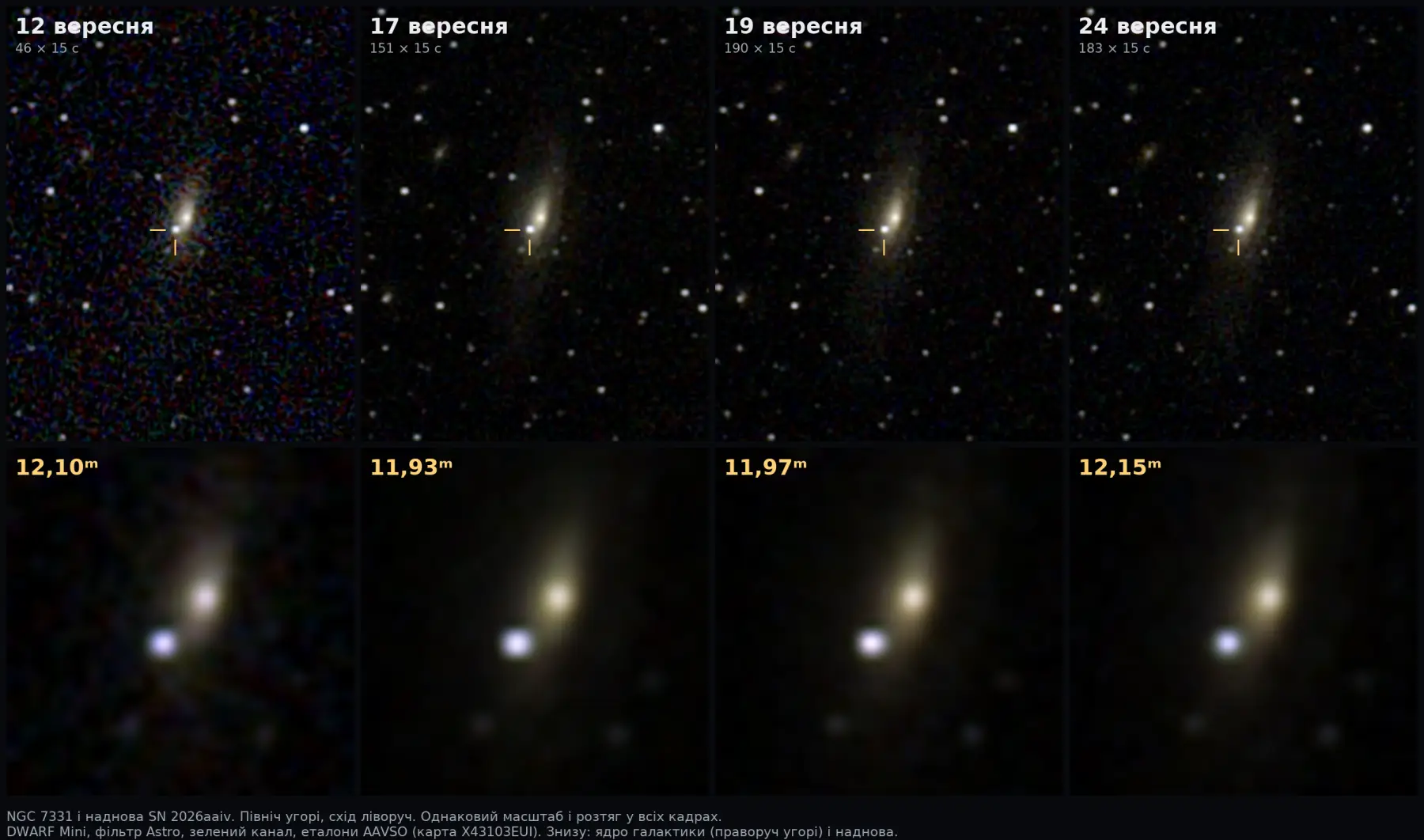
NGC 7331 in Pegasus, a large spiral galaxy similar to the Milky Way in size and shape, tilted so that both the disk and the dust lanes are visible. Behind it in the same field lie several much more distant galaxies that only appear to be its companions. In 2026 supernova SN 2026aaiv flared up in NGC 7331, and this page keeps the frames with it: a star that for a few weeks shone like billions of ordinary ones.
Distance: about 40 million light-years, apparent size in the sky: 10′ × 4′, constellation Pegasus.
How it was shot
Everything here was shot with a DWARF Mini smart telescope from a balcony in a city in Ukraine: light-polluted sky, only the eastern half of it visible, and a roof overhang that cuts off the south. 7 nights (4 nights in September and 3 in October), 7 sessions, 881 frames with exposures of 15 and 30 s, without a filter, in broadband. The stack holds 3 h 36 min of light; the longest night, 19 September, gave 54 min. The goal for this object is 8 h, 44% done so far. First night 12 September 2026, last one 11 October 2026.
Galaxy NGC 7331 (Caldwell 30) + SN 2026aaiv in the night log: 12 September, 17 September, 19 September, 24 September, 1 October, 10 October, 11 October.
How it went
This galaxy entered the series because of the supernova: five nights without a filter at 15 and 30 seconds, to record SN 2026aaiv before it faded. From a balcony the galaxy itself is small and unassuming, but the supernova on its edge stands out confidently, and frames from different nights show its brightness changing. It is the only object in the challenge shot for the event rather than for the galaxy.
More images
All objects