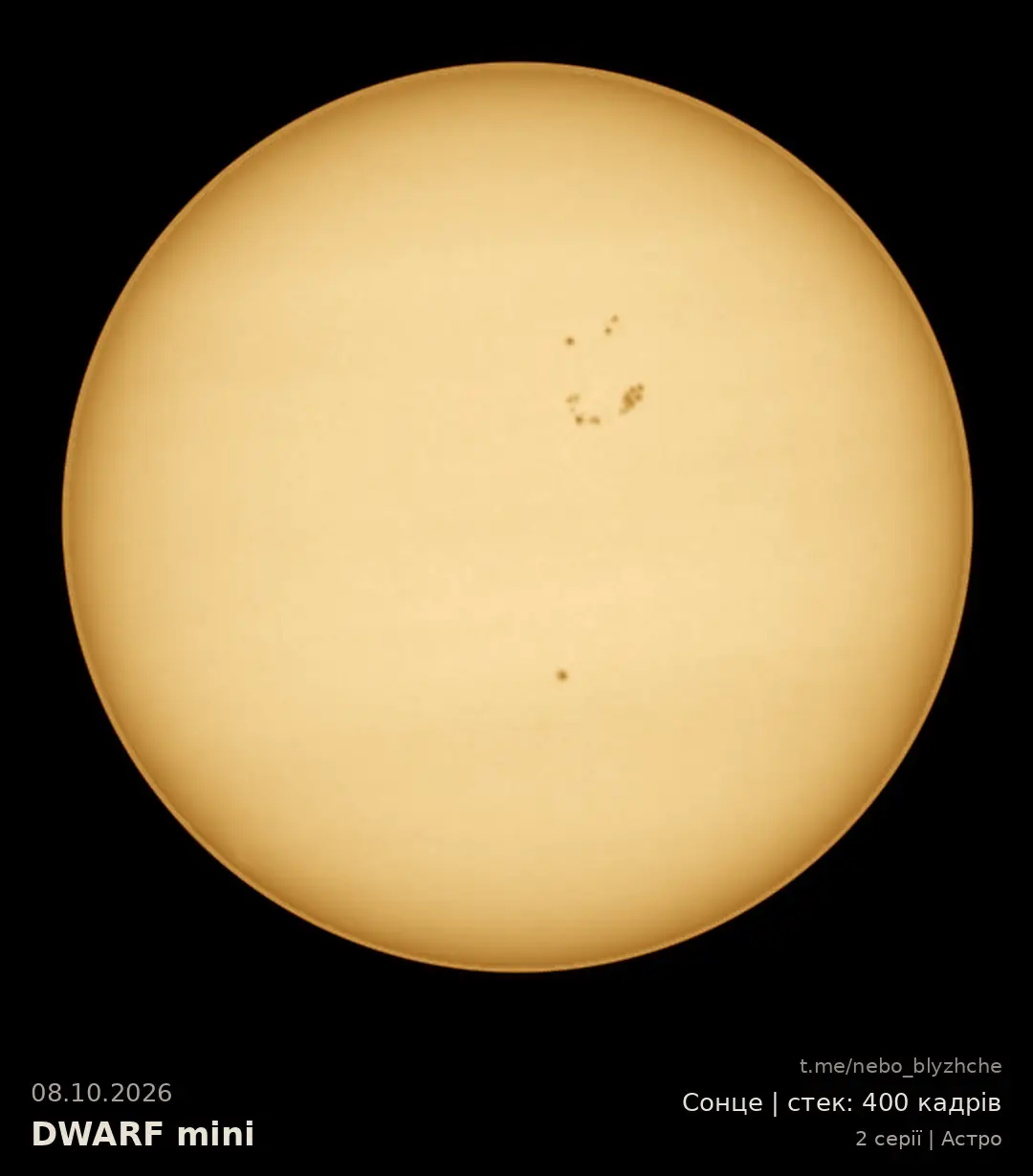
Sun
- Nights
- 11
- First and last night
- 20 August … 12 October
- Image from
- 8 October 2026
- Telescope
- DWARF Mini, city balcony
About the object
The Sun, the only star we can look at up close. Through a solar filter the disk shows spots, dark regions with strong magnetic fields slightly cooler than the rest of the surface, and bright faculae near the limb. The number of spots rises and falls in a cycle of roughly eleven years, and activity is high right now, so the disk is rarely empty. The Sun may only be photographed through a special filter that passes less than a thousandth of the light.
Apparent size in the sky: ≈ 32′.
How it was shot
Everything here was shot with a DWARF Mini smart telescope from a balcony in a city in Ukraine: light-polluted sky, only the eastern half of it visible, and a roof overhang that cuts off the south. The Sun was observed over 11 nights (1 night in August, 6 in September and 4 in October) in 15 sessions, 1,540 frames with exposures from 0.5 ms to 6.25 ms, filter: a solar ND filter. For the Moon, the Sun and the planets the telescope records short video and the sharpest frames are stacked, so a few good minutes of steady air matter more than hours of exposure.
Sun in the night log: 20 August, 4 September, 13 September, 21 September, 25 September, 26 September, 1 October, 2 October, 7 October, 9 October, 11 October, 12 October.
How it went
Solar sessions happen in daytime, so neither light pollution nor the Moon gets in the way; what does is the daytime shimmer of air above heated roofs. I shoot through an ND filter in short bursts, and the morning hours give the best frames. Spots and spot groups are tracked day by day: over a few days you can see them rotate with the Sun and change shape.
3D flight through the image
A short loop of a 3D flight through this image. You can watch the full clip with sound right here.
More images
All objects